

The Comments Under the Announcement
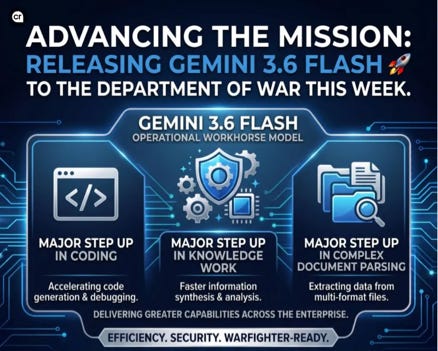
Last week, the DoW CDAO announced that Gemini 3.6 Flash is now available across the Department of War. The post itself reads like every rollout announcement: faster, more capable, five of six services on board. The comments underneath are where it gets interesting.
One Marine Corps officer asked the question everyone in the thread was circling:
“How do you embed a model like this into SharePoint, inside M365, where people already work?”
The API exists, but firewall restrictions make reaching an external AI service a fight before anyone writes a prompt. A Navy business analysis director said it more plainly:
“Microsoft’s own restrictions on anything outside Copilot mean most staff still can’t get it, and what they actually want is AI inside SharePoint itself, rather than ‘relying on user knowledge to find what we need.’”
A government AI integration consultant zeroed in on document parsing: “extraction accuracy looks great on a clean file and falls apart on a scanned twenty-year-old attachment, which is most of what government work runs on.”
A Pattern We Already Named
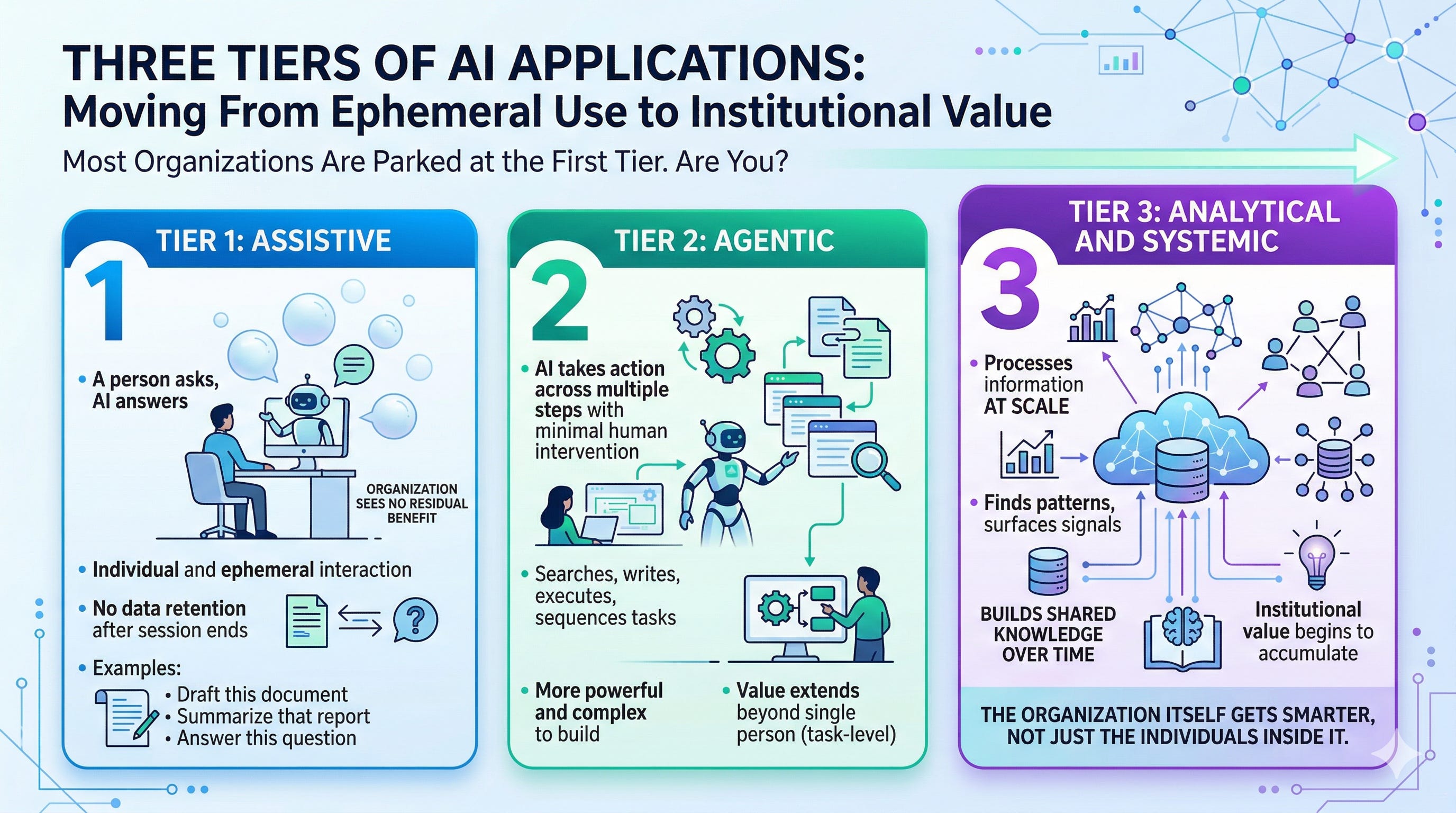
None of that is a knock on the model. It is the same pattern we named in April, when we introduced a framework for sorting organizational AI use into three tiers. Tier 1 is assistive: a person asks, the model answers, the session ends, nothing is retained. Tier 2 is agentic: multi-step, less supervised, still task-bound. Tier 3 is where institutional value actually accumulates, and we argued then, and again in July, that getting there is a data architecture problem before it is an AI model problem. This comment thread is that argument playing out in real time, from people doing the work, not from a slide.
What Doesn’t Survive Contact
We spent time this summer analyzing three AI platforms available to DoW organizations, not against a marketing sheet but against what operationalizes. A lot of what passes for AI strategy right now is performative theater: a capability that looks impressive in a pilot and never touches a live system or a slide that says accredited without saying accredited for what, or reachable by whom.
That is the gap we look for and name plainly. The most capable model in the building cannot see the SharePoint list a staff section maintains by hand, or the Dataverse table it is migrating to, unless someone builds a bridge, and that bridge runs into the same security controls that exist for good reason. This is not solely a DoW problem; every organization we talk with hits some version of it: a firewall, a compliance boundary, a vendor contract that has not caught up to the tool.
What the comment thread adds to our earlier argument is a piece we underweighted. Even once access is solved, two things determine whether it stays solved:
The first is personnel turnover. Whoever builds the workaround eventually moves on to the next assignment, and if it was not documented, it goes stale quietly, and the next person inherits something they are afraid to touch.
The second is uneven fluency. A handful of people in any organization are genuinely experts with this technology; most are not, and there is rarely a role or a budget line to close that gap before these experts rotate out as well.
We have observed three responses to this, and all three solve access while leaving durability untouched:
Manual export works until the person who remembers to do it forgets, or leaves.
Full platform integration is genuinely powerful once built, but it requires engineers who understand pipelines and data models, and it breaks the day someone adds a column nobody told the engineers about.
Flexible, staff-buildable tools clear the skill barrier but hand someone a metered bill and a governance question to own indefinitely, long after the person who set it up has moved on.
The Question We’re Still Asking
Back in April, we asked whether anyone had a real plan across all three tiers. We are asking a simpler version of that question now:
“Has anyone actually made this last? Not survived a pilot, but lasted through the people who built it leaving and new people taking over, without turning the whole staff into AI administrators just to keep it running.”

Our guess is that it comes down to one thing: “Does someone actually own this, day to day?” Most organizations do not have that person. If you have seen it work, or watched it fall apart, we would like to hear about it either way.
These three platforms are specific to DoW; a commercial firm chooses from a different, often more confusing, set of options. But the underlying question is the same: which platform, at what cost, sustained by whom?
If a no-nonsense breakdown of your own options would help, ask and we will work with you. That judgment call is exactly the kind of work we do for organizations that need it handled but do not have full-time oversight. Reach us at info@stormkinganalytics.com.