
Everyone’s Building Agents. Almost Nobody’s Built the Foundation.
Tier 2 has a hidden prerequisite. Most organizations haven’t built it.


In April, we introduced a framework for cutting through the noise around AI adoption. It sorts organizational AI use into three tiers, and they are not equal.
Tier 1: Assistive. A person asks and AI answers. The interaction is individual and ephemeral. When the session closes, nothing is retained, and the organization sees no residual benefit.
Tier 2: Agentic. AI that takes action across multiple steps with minimal human intervention. More powerful, more complex to build responsibly, and increasingly accessible to technically capable individuals.
Tier 3: Analytical and Systemic. AI that processes information at scale to find patterns, surface signals, and build shared knowledge over time. This is where institutional value begins to accumulate. The organization itself gets smarter, not just the individuals inside it.
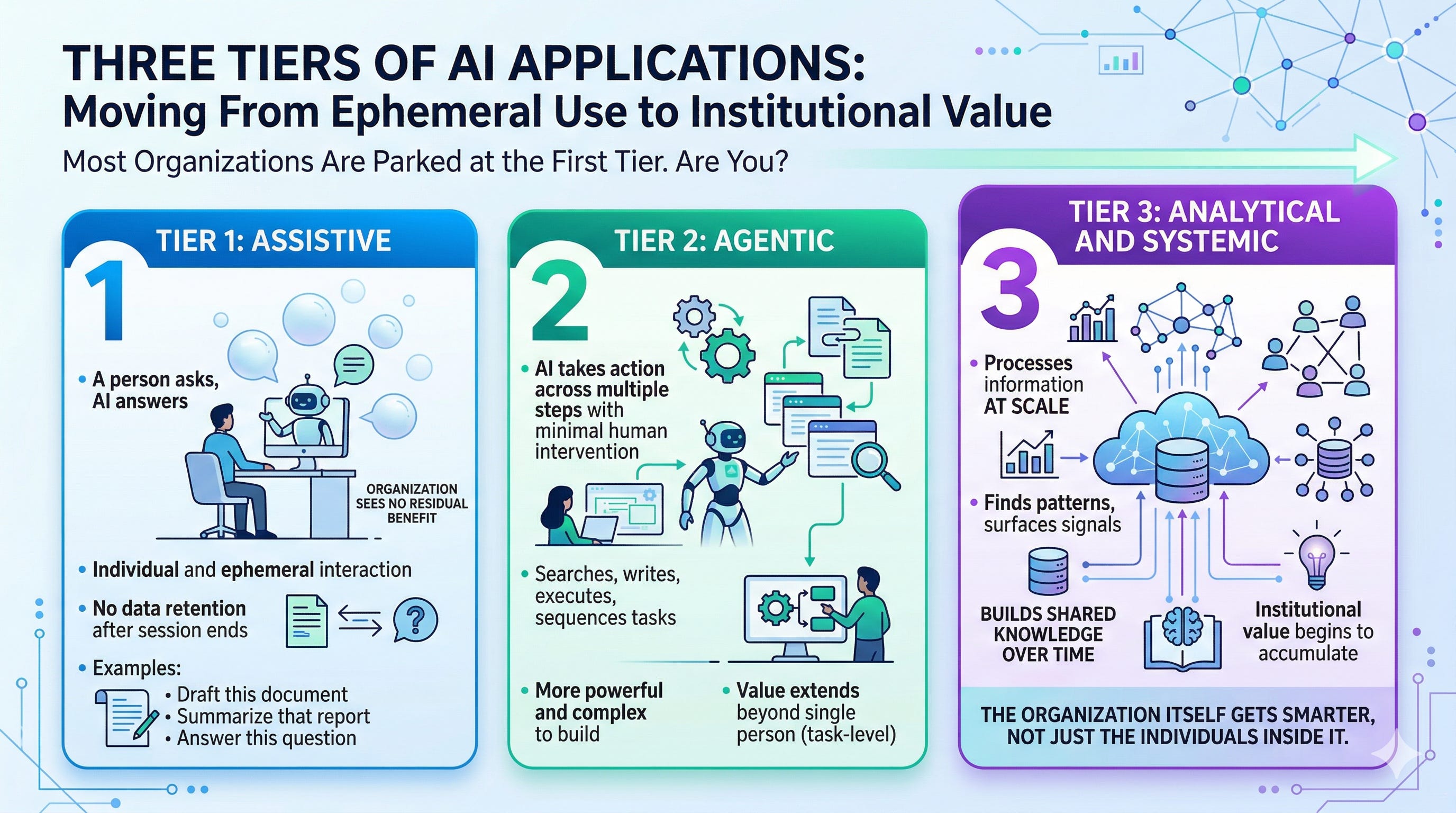
Most organizations remain parked at Tier 1. The harder question, as we argued then, is which tier, toward what end, governed by what framework, and building toward what kind of institutional capacity. Reaching Tier 3 requires something that precedes the AI entirely. It is not primarily an AI problem; it is a data architecture problem.
What we did not fully name is what happens when organizations try to close that gap by deploying agents.
The Work That Kills Most Projects
Ben Lorica at Gradient Flow recently spoke with Andrew Moore, former head of Google Cloud AI and former dean of Carnegie Mellon’s School of Computer Science, about exactly this problem. Moore’s observation is worth sitting with: agents need maps, not bigger context windows. A bank investigating exposure to a sanctioned shipping company might need to connect ownership records, trade data, vessel movements, subsidiaries, legal filings, and recent news. Vector search can surface relevant documents, but it cannot follow relationships across entities and events. For that, there has to be a structured, continuously updated map of what the organization knows and how those things connect.

Building that map is where most enterprise AI projects die. Not during the AI work, before it. The culprit is entity resolution: the problem of knowing whether “IBM,” “International Business Machines,” an internal vendor ID, and a name in a filing all refer to the same thing. Anyone can prototype a solution over a weekend. Making one that scales, handles multiple languages, adapts to entirely new entity types, and updates continuously is, in Moore’s framing, brutally hard. It is also the unglamorous work that determines whether agents produce answers that can be trusted, or answers that merely sound confident.
The three-tier framework pointed at this from one angle: Tier 3 is a data architecture problem before it is an AI problem. Moore arrives at the same conclusion from a different direction. The agent is only as good as the context it can navigate.
“The Model Said So” Is Not Enough
There is a second dimension to this that matters particularly for organizations operating in high-stakes environments. Lorica’s conversation with Moore makes this clear: in regulated or consequential settings, it is not sufficient for a system to produce an answer. It must show where a fact came from, how it was connected to other facts, and what the system believed at the moment it generated a response. Lineage, provenance, and version control. A regulator, a reviewer, or a commander asking why an agent flagged a transaction or recommended a course of action will not accept “the model said so” as an answer.

This will be familiar to anyone who has followed our writing on dashboards and data trust. A confident-looking surface is not the same as a trustworthy one. The agentic layer has inherited that problem and amplified it. The outputs are harder to interrogate than a chart. The surface confidence is greater, and the decisions being made on the basis of those outputs are moving faster than the oversight capacity to check them.
What Has to Exist Before the Agent Can Work
The three-tier model has a hidden floor. Before an organization can reach Tier 2 reliably and Tier 3 at all, a disciplined architecture for what the organization “knows” has to exist: structured, traceable, continuously updated, and built with provenance from the start rather than retrofitted later.
Most organizations are skipping this entirely. They are deploying agents into the same fragmented, inconsistent information environment they already had and discovering that AI layered on top of broken systems does not transform them; it accelerates them.
This is the problem we have been building toward at Storm King Analytics. The platform in development is designed to address exactly this gap: converting unstructured organizational information into structured, auditable intelligence, with entity resolution, origin tracking, and validation built into the architecture from the beginning. We are engaged with select partners on the core design and will have more to say about the specifics in the coming weeks.
For now, the question worth asking is not whether your agents are capable. It is whether the foundation they are navigating is one you could actually defend.
If this challenge is live in your organization, we would be glad to continue the conversation at info@stormkinganalytics.com. Next, we will look more closely at what that foundation requires to build.